26
Nov
AI Skills, UK Competitiveness and Why Policy Makers and Businesses Must Act Now
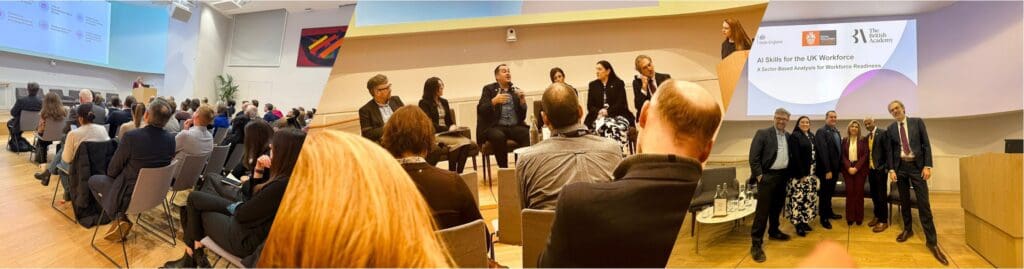
Over the past week I’ve had the privilege of speaking at two panel discussions in...
Read More
2026 Marketing Masterclass Announced: Shop Early Bird Offers Here

In this interview with DM News English, Steve Pailthorpe shares practical insight into how AI is reshaping UK businesses and where the real opportunities are for leaders willing to act early.
The conversation focuses on productivity, skills and how to move beyond experimentation to embed AI in ways that support long-term growth.
You can watch the full video below or read the complete transcript to explore the discussion in more detail.
Alex Izatt: UK productivity has stalled again, according to the latest economic data, with analysts pointing to a widening skills gap as firms adopt new digital systems faster than their workforce can keep up. Government departments are now under pressure to show how they will raise digital capability across the public and private sector, after repeated warnings that the UK risks falling behind competitor economies in Europe and Asia.
In response to that gap, AI strategist Steve Pailthorpe has launched a free online hub aimed at giving business leaders practical tools to upgrade their digital skills. The site consolidates training materials, white papers, and step-by-step guidance focused on how AI is already reshaping day-to-day operations inside UK companies. I spoke to Steve earlier to find out where he thinks the biggest skills failures are happening, what he’s seeing from the firms he advises, and what leaders should prioritise as AI-driven systems continue to roll out across the economy.
So Steve, thank you so much for joining me today. Let’s talk a little bit about your company. UK productivity is down at the moment. Is this why you started your online hub or are there a whole host of reasons?
Steve Pailthorpe: Well, great question, and it’s great to be with you today. For the last 15 years, we’ve been pioneering a scientific and innovative approach to online marketing that guarantees return on investment for each of our clients.
As an agency, Iconic Digital has really been leading the charge here in London and across Europe in terms of using digital marketing effectively. What we’ve been seeing over the last three years, obviously with the introduction of artificial intelligence, is a gradual trend towards more and more companies embracing AI in the fabric of their organisations.
So we’ve moved from an environment where people were experimenting with generative AI tools, running three-month pilots, to now a new phase of generative AI where technology is becoming embedded into the foundations of businesses.
We realised very quickly that we needed to pioneer something within our space to offer companies the opportunity to properly utilise artificial intelligence and embed it into their infrastructure. That’s why we launched the new brand and the new website, alongside a whole host of generative AI tools that will be rolling out over the course of the next year.
Alex Izatt: There are obviously lots of different types of AI, as you mentioned there, and it can be quite overwhelming for some companies. Do you find that businesses are potentially going down the wrong path because they don’t really understand the differences?
Steve Pailthorpe: Yes, absolutely. The Government has just launched its AI Skills Framework, which provides a pathway for SMEs to adopt AI within their organisations.
One of the things we’re finding is that most people are using what we call large language models. These are tools people are most familiar with, such as OpenAI’s ChatGPT, Microsoft Copilot, Claude, and a whole host of others.
Most people are using these tools to try to improve personal productivity. We’re seeing people writing emails with AI, simplifying tasks, and analysing data. But we have to remember that AI isn’t just about speeding things up or making things simpler.
Large language models, at their foundation, offer predictive analysis of text. They’re great for accessing information, but unless you really understand how they work and how to prompt them correctly, you’ll get poor outputs. Bad prompting leads to bad responses.
We’re also seeing issues around bias, particularly because many AI tools have been built in the US or the Western world. When these tools are applied in African or Asian contexts, for example, cognitive bias can creep in.
It’s really important that viewers understand how AI works. If you’re using a large language model in your organisation, you need to invest in the skills required to get the most out of it.
That’s why we built what we call the CREATE framework. It’s a very simple model for getting the best outcomes from large language models.
CREATE stands for Character, Request, Examples, Adjustments, Type of output and Extras.
So first, the character. Who is the AI acting as? A solicitor, a business coach, a consultant, for example.
Then the request itself.
Then examples to guide the response.
Then adjustments, where you iterate and refine the output.
Then the type of output you want.
And finally, any extras.
With the acceleration in AI and new capabilities being released all the time, such as advanced reasoning models, unless you include certain prompts in that extras section, you won’t get the best results.
For example, we often include something as simple as: “Before generating the response, ask me any relevant questions that will improve the output.” That forces the model to think more deeply and produce a more structured and useful result.
Alex Izatt: That sounds like common sense when you explain it that way. But humans tend to look for shortcuts. Are people still being a bit lazy and not using frameworks properly?
Steve Pailthorpe: That’s probably true. If we can find shortcuts, we’ll take them. But one of the things AI is actually doing is levelling up the workforce.
People who don’t have English as a first language, or junior colleagues fresh out of university, can now communicate at a mid-management level using AI.
That’s a huge opportunity. But AI doesn’t replace thinking time. It creates space for creativity and strategy. It doesn’t replace human interaction. It acts as a cognitive assistant.
For small business owners embracing AI, it’s vital not to just throw employees into it without any framework. You need to create an environment where people can experiment, learn and grow.
There are also privacy considerations. If you’re uploading personal data into AI tools, be aware that many of these services are hosted outside the UK. You must anonymise data and think carefully about privacy and infrastructure.
But let me be clear. The businesses that will grow are the ones that embed generative AI into the fabric of their operations, not those who simply bolt it on.
If you look at every major revolution in history, from the Industrial Revolution to electric vehicles, the winners weren’t the ones who treated it as an add-on. They embedded it into how they worked.
Many futurists believe AI will create more multi-millionaires in the next six months than in the last six years. That’s genuinely exciting, especially for the UK.
Alex Izatt: That sounds great, but many employees are worried about their jobs. They hear AI and think redundancy. What do you say to that?
Steve Pailthorpe: AI is absolutely going to change jobs. Many functional, repetitive tasks will disappear. That’s inevitable.
The question is how you respond. Do you resist it, or do you reskill?
In our agency, we’ve used AI for years across SEO, paid media, content and social. Over the next three years, I can easily see 90 percent of certain tasks being replaced by AI.
That doesn’t scare us. It creates opportunity. Roles evolve. Human interaction remains critical.
I say this a lot to young people: we need each other. AI will never replace human connection.
If AI can handle routine tasks, it frees us to think, create, and communicate at a higher level. That’s where the value is.
Alex Izatt: What about young people still in school or college, looking at such an uncertain future?
Steve Pailthorpe: The pace of change is accelerating. I would love to see what the next ten years holds, but what I can say is this: embrace every opportunity to learn.
We now talk about search everywhere optimisation, not just search engine optimisation, because people don’t only search on Google anymore. They search on ChatGPT, Copilot and elsewhere.
We are living through exponential change. That creates risk, but it also creates opportunity. I believe we’re moving towards accelerated learning and a broader sharing of resources.
However, unless we pragmatically update our education systems and focus on AI skills, we risk leaving young people unprepared.
I’m a parent governor at a school. I have a ten-year-old and an eight-year-old, and I’m already teaching them prompt engineering. That will be part of their future.
If you’re a student, an employee, or a business owner, my advice is simple: jump in with both feet. AI isn’t going away. It’s about how we adopt it quickly and ethically.
Alex Izatt: Ethics and security are big concerns. How do we protect young people?
Steve Pailthorpe: AI is like the Internet. It’s powerful, but it has risks. Security and parental controls are essential.
Mainstream platforms like OpenAI and Microsoft already have strong safeguards. Parents should use these tools alongside their children, with boundaries and education.
If you’re concerned about privacy, anonymise your data or don’t upload it at all. Choose reputable providers and understand the constraints.
Alex Izatt: Finally, will your online hub expand to help young people and parents as well as businesses?
Steve Pailthorpe: Yes. In early 2026, we’re launching Iconic Intelligence, which will include tools and incubator modules to help students and young people build AI skills.
There are already free resources on my personal website, including podcasts and training materials. We also run free monthly webinars and discounted in-person events for young people.
This technology can genuinely improve lives if we use it well.
Alex Izatt: Steve, thank you so much for your time. That was Steve Pailthorpe from Iconic Digital, speaking to us about the future of AI and what it means for the next generation. For DM English News, I’m Alex Izatt.
Explore Steve Pailthorpe’s extensive range of whitepapers and blogs, all with audio to listen to on-the-go.